As an Amazon Associate we earn from qualifying purchases. Here’s how it works.
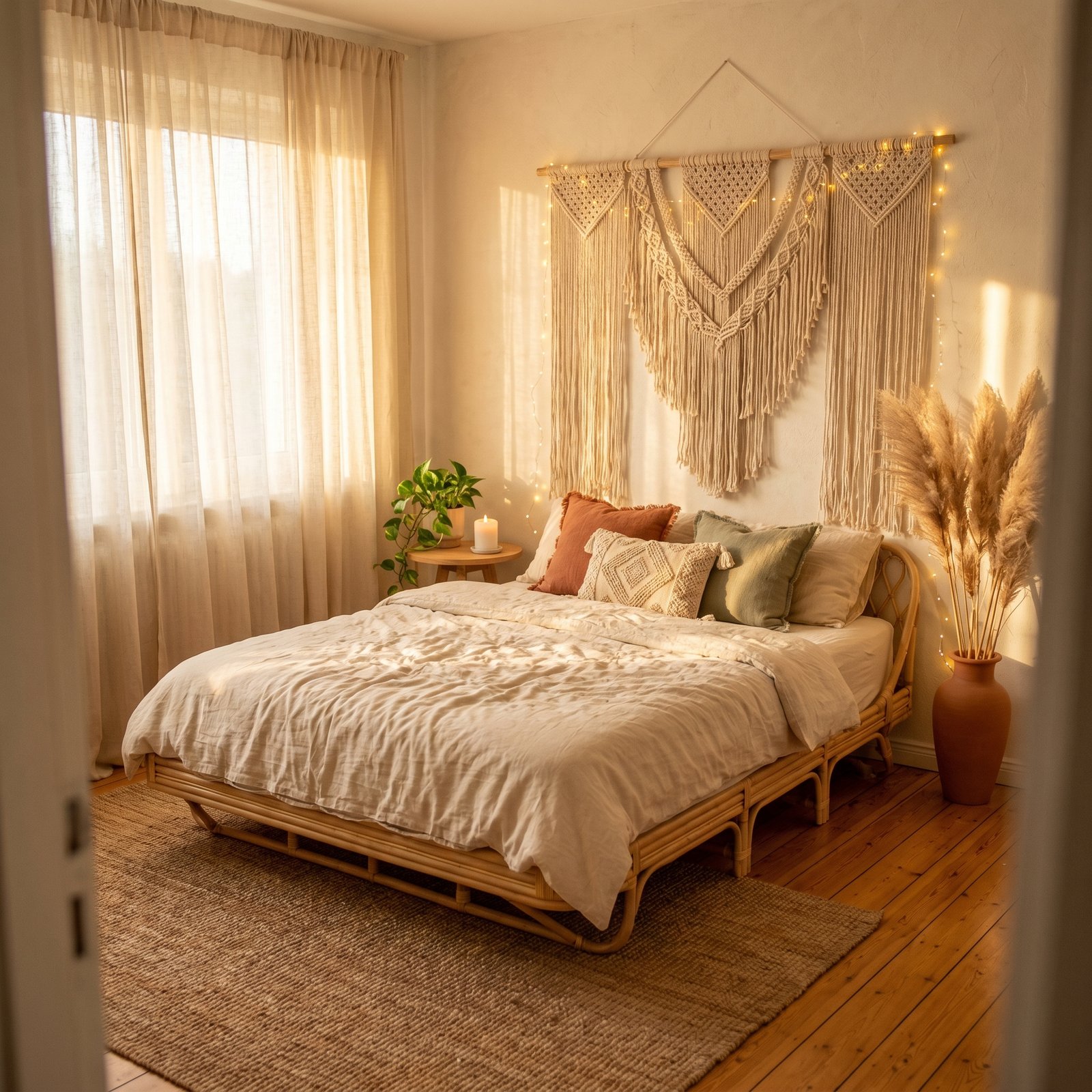
Macramé, rattan, pampas grass, layered textures — a complete style a boho bedroom with Amazon Finds guide with every piece under $50.
Let’s be honest about something: every time you scroll through Pinterest and stop on a gorgeous boho bedroom — the one with the macramé wall hanging, the rattan pendant light, the dried pampas grass in a terracotta vase — your first thought is probably “that’s beautiful” immediately followed by “there’s no way I can afford that.”
Here’s the thing. You absolutely can.
Bohemian style is arguably the most budget-accessible interior aesthetic in existence, because its entire philosophy is built around layered textures, natural materials, handcrafted-looking pieces, and intentional imperfection. None of those things require a designer budget. They require good taste, the right sources, and knowing what to buy.
Amazon — yes, Amazon — has quietly become one of the best places to find genuinely beautiful boho bedroom pieces. Not knockoff-looking, not cheaply made, not embarrassing. Real macramé, real rattan, real dried botanicals, real woven textiles. Most of it under $50. Some of it under $20.
This guide is going to walk you through every element of a styled boho bedroom from scratch: what to buy, where to put it, how to arrange it, and exactly what the result will look like. By the end, you’ll have a perfectly styled boho bedroom that looks stunning and impresses your guests.
Let’s build it.
What Makes a Bedroom Actually Look Boho?
Before we talk products and placement, it’s worth understanding the five design principles that make a bedroom read as “effortlessly bohemian” rather than “randomly decorated.”
1. Layered Textures Over Matched Sets Boho bedrooms don’t have matching bedroom sets. They have a jute rug under woven cotton pillows under a linen duvet under a knit throw. Each piece has its own texture, and together they create visual depth that feels rich and intentional even when every item is affordable.
2. Natural Materials Everywhere Rattan, cane, jute, seagrass, cotton rope, dried botanicals, terracotta, raw wood — these are the vocabulary of boho design. They feel warm and organic in a way that plastic and synthetic materials simply don’t, and they photograph beautifully.
3. Warm, Earthy Color Palette Think: terracotta, sage green, mustard, dusty pink, warm cream, natural oat, rust, and sand. These tones are inherently cohesive — they don’t clash, they layer, and they make any room feel cozy and intentional without requiring a color consultant.
4. Intentional Imperfection The macramé is slightly asymmetric. The pampas grass is loosely arranged, not perfectly symmetrical. The throw pillows are casually stacked, not karate-chopped into military precision. Boho style is the aesthetic permission slip to let things be beautifully imperfect.
5. Statement Pieces That Do Heavy Lifting One large macramé wall hanging. One pendant rattan light. One dramatic dried botanical arrangement. Boho bedrooms often have one statement piece per zone that does all the visual work — and everything else simply supports it.
Once you understand these five principles, everything else becomes a styling decision rather than a guessing game.
Also Read: Decorative Pillow Combinations That Instantly Upgrade Any Sofa
Your Complete Boho Bedroom Shopping List (All Amazon, All Under $50)
Here’s every item you need, organized by category and function. I’ve included price ranges based on current Amazon listings so you can budget accordingly.
Macramé & Textile Wall Art
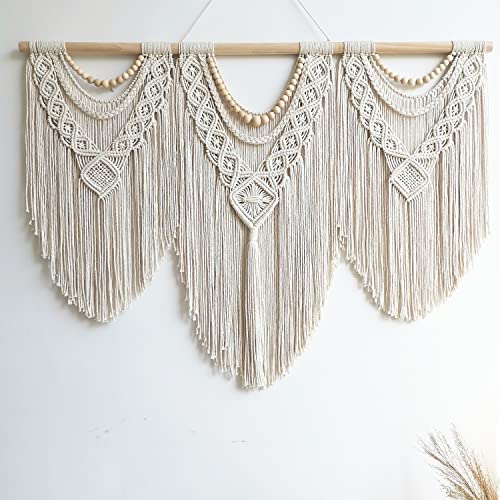
Large Macramé Wall Hanging — The anchor piece of any boho bedroom. Look for one in natural undyed cotton rope with fringe detail, at least 20″ wide. Wall-to-wall coverage looks the most editorial, but even a 20″–30″ piece above a bed headboard is transformative.

Woven Tapestry — For a second wall or above a dresser. Mandala patterns, geometric weaves, or simple sunrise gradients in terracotta/cream tones all work perfectly.
Lighting
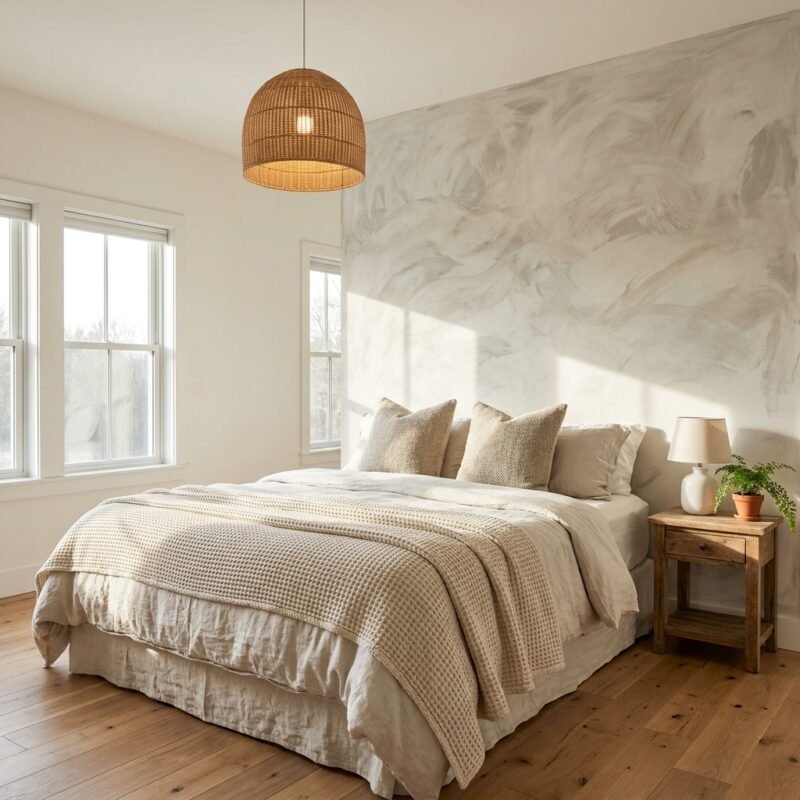
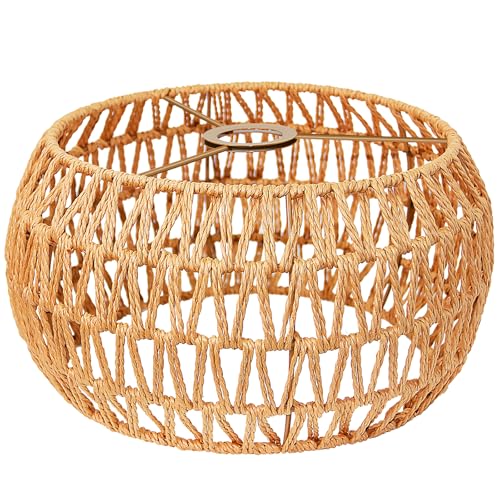
Rattan Pendant Lamp Shade — This single item changes a bedroom more dramatically than almost anything else on this list. A natural woven rattan dome shade transforms a basic ceiling fixture into a full boho statement. Most are pendant conversion kits — you just swap out your existing shade.
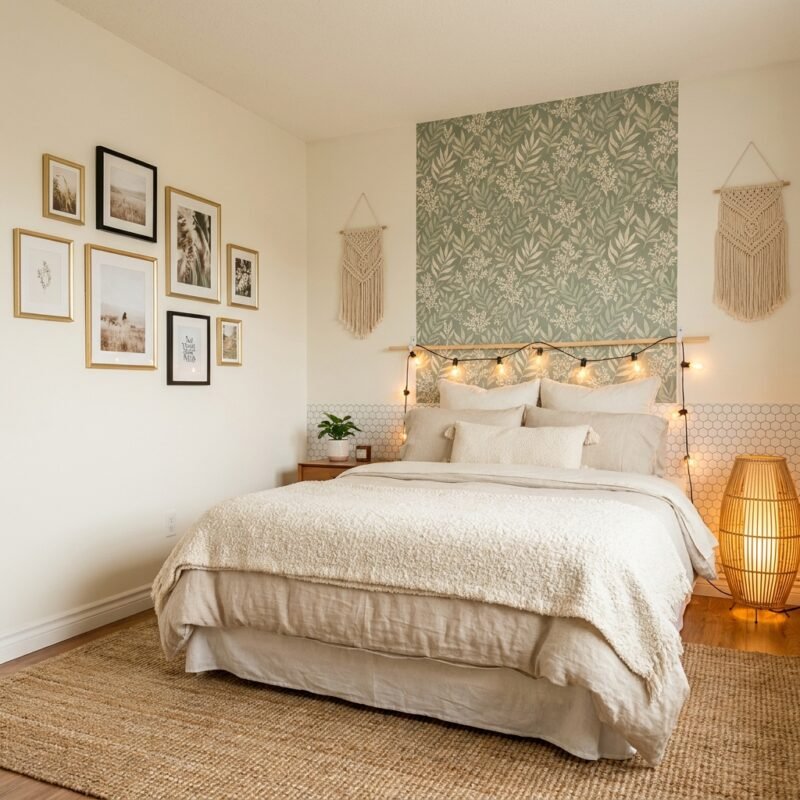
Warm White LED Fairy Lights (Copper Wire) — Battery-operated, no outlet needed. Drape them around your macramé, along a window frame, or in a loose cascade behind your headboard. The warm glow they add in the evenings is genuinely transformative.

Rattan Table Lamp — For the bedside table. Natural woven base, cream linen shade. Immediately reads as $150+ even when it’s $38.

Botanicals & Natural Decor
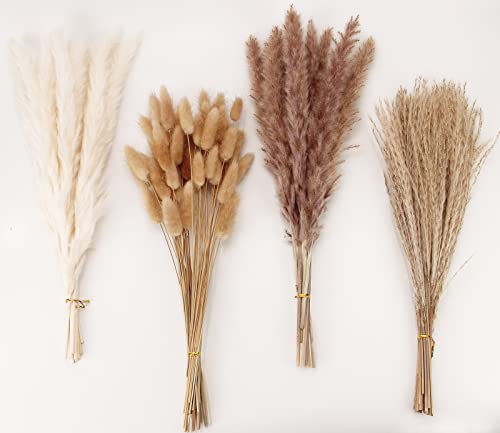
Dried Pampas Grass Stems — The most-pinned boho plant on the internet. A bundle of 10–15 stems in a tall terracotta vase creates a dramatic, flowing, organic statement in any corner of the bedroom. Once you buy them, they last for years.
Trailing Pothos Plant (Faux or Real) — Real is always better if you have the light for it, but high-quality faux trailing pothos from Amazon has gotten genuinely convincing. Perfect in a hanging planter or on a shelf to trail downward.

Dried Bunny Tail Grass / Dried Botanicals Mix — Small bundles of dried bunny tail grass, dried lavender, or dried wheat stalks in small terracotta or ceramic bud vases make perfect bedside table accents.
Bedding & Pillows
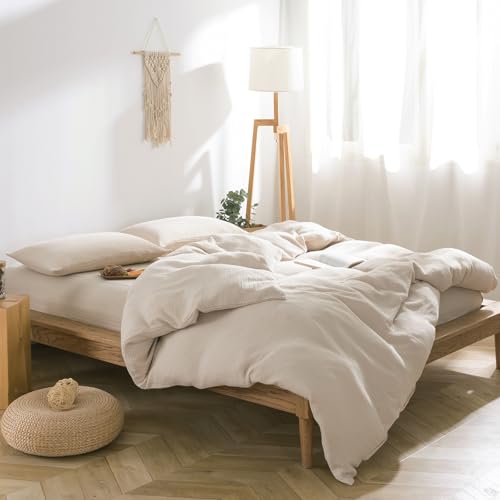
Linen or Linen-Look Duvet Cover — Natural oat/cream, sage green, or dusty terracotta. The slightly wrinkled, lived-in look of linen is a boho bedroom essential. Don’t iron it. The wrinkles are the point.
Woven/Textured Throw Pillow Covers — Buy covers, not pillows. They’re cheaper, take up less storage, and you can switch them seasonally. Look for a mix of: (1) solid terracotta, (2) cream tufted cotton, (3) sage green woven, (4) mustard or tan geometric.

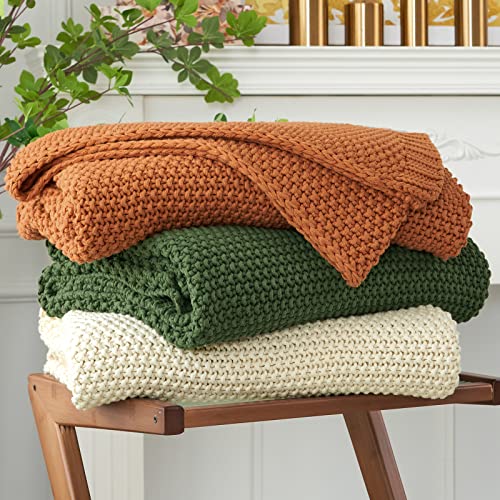
Chunky Knit Throw Blanket — Draped loosely across the foot of the bed or casually hanging off one corner. Natural cream, terracotta, or sage green.
Storage & Furniture Accents
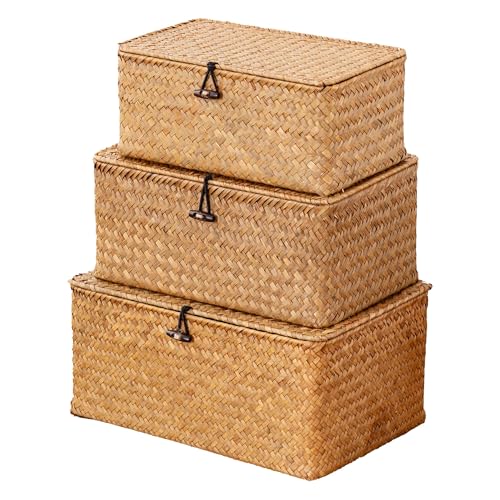
Natural Seagrass Baskets with Lids — For storage that looks intentional rather than utilitarian. Two stacked in a bedroom corner, or one beside the bed holding extra blankets. They photograph beautifully and are incredibly functional.
Small Round Wooden Side Table — A single-leg or tripod round teak or mango wood bedside table under $50 can look expensive and intentional in a boho bedroom. Simple, organic, warm-toned.

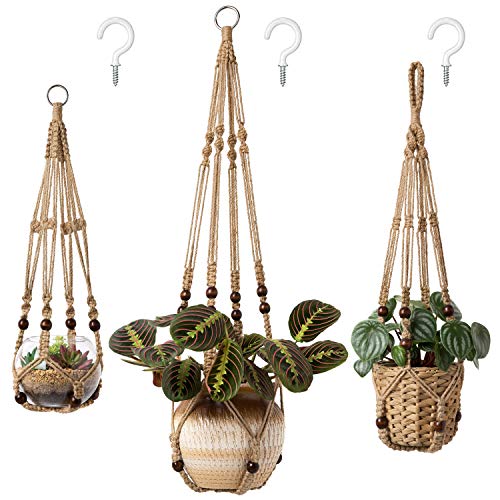
Macramé Plant Hanger — For displaying your trailing pothos or any hanging plant. Natural cotton rope, simple or tiered design.
Flooring & Layering
Natural Jute Rug — The base layer of any boho bedroom. Natural jute in a simple braided, herringbone, or circular pattern grounds the whole room. The texture adds warmth that no painted floor or plain carpet can replicate.

Step-by-Step: How to Style Your Boho Bedroom
Now that you have your pieces, here’s exactly how to put it all together. Follow this sequence — it matters, because each layer builds on the one before it.
Step 1 — Lay the Foundation: Rug First
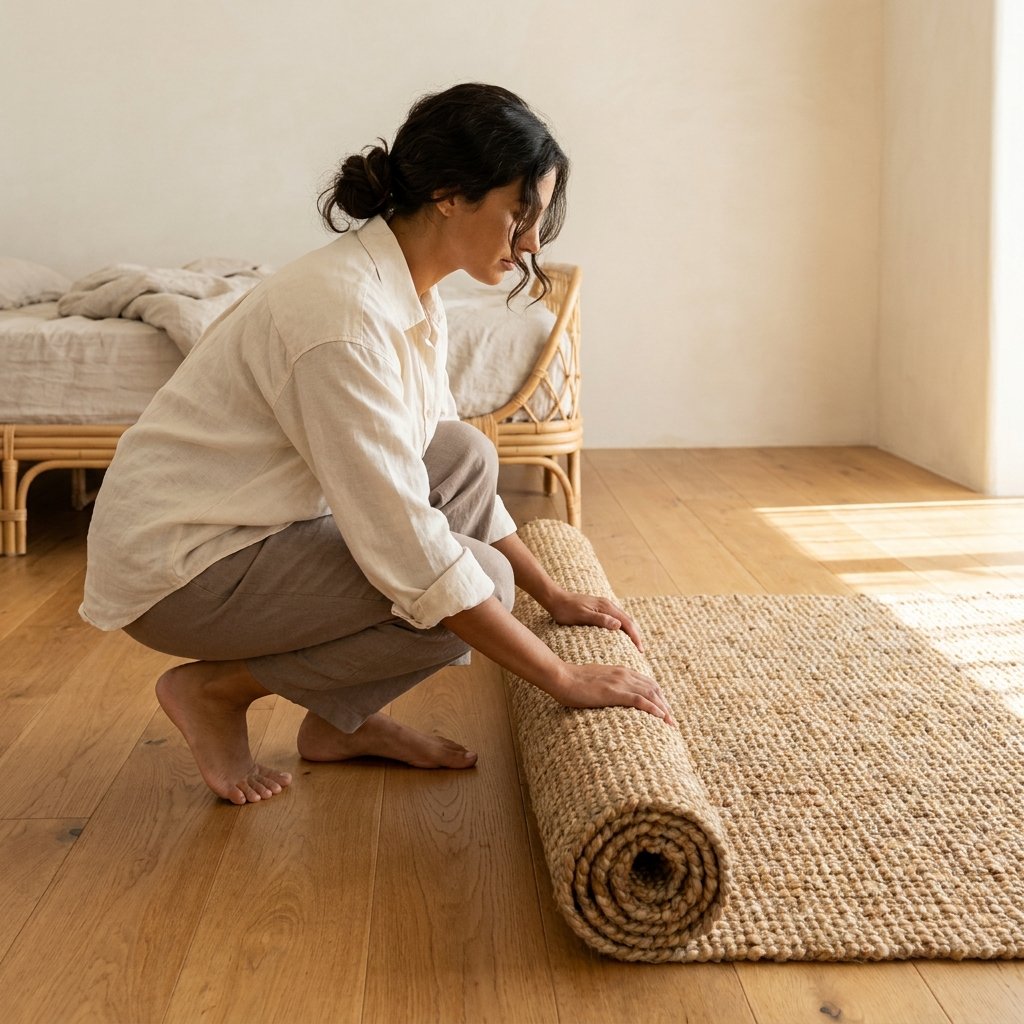
Start with the floor before you touch a single wall or surface. The jute rug is your visual anchor — it defines where the “bedroom zone” lives and sets the warm, natural tone for every layer that follows.
Roll it out centered under your bed so that approximately 18″–24″ of rug extends beyond the bed on both sides and at the foot. This makes the room feel intentionally designed rather than incidentally decorated.
Why this matters: In boho bedrooms, a rug that’s too small makes the entire room feel disconnected and cheap. If your rug doesn’t extend past the sides of your bed, size up. A 8’×10′ for a queen/king bed, or a 5’×8′ for a full/double, is the minimum.
Step 2 — Hang Your Rattan Pendant Light
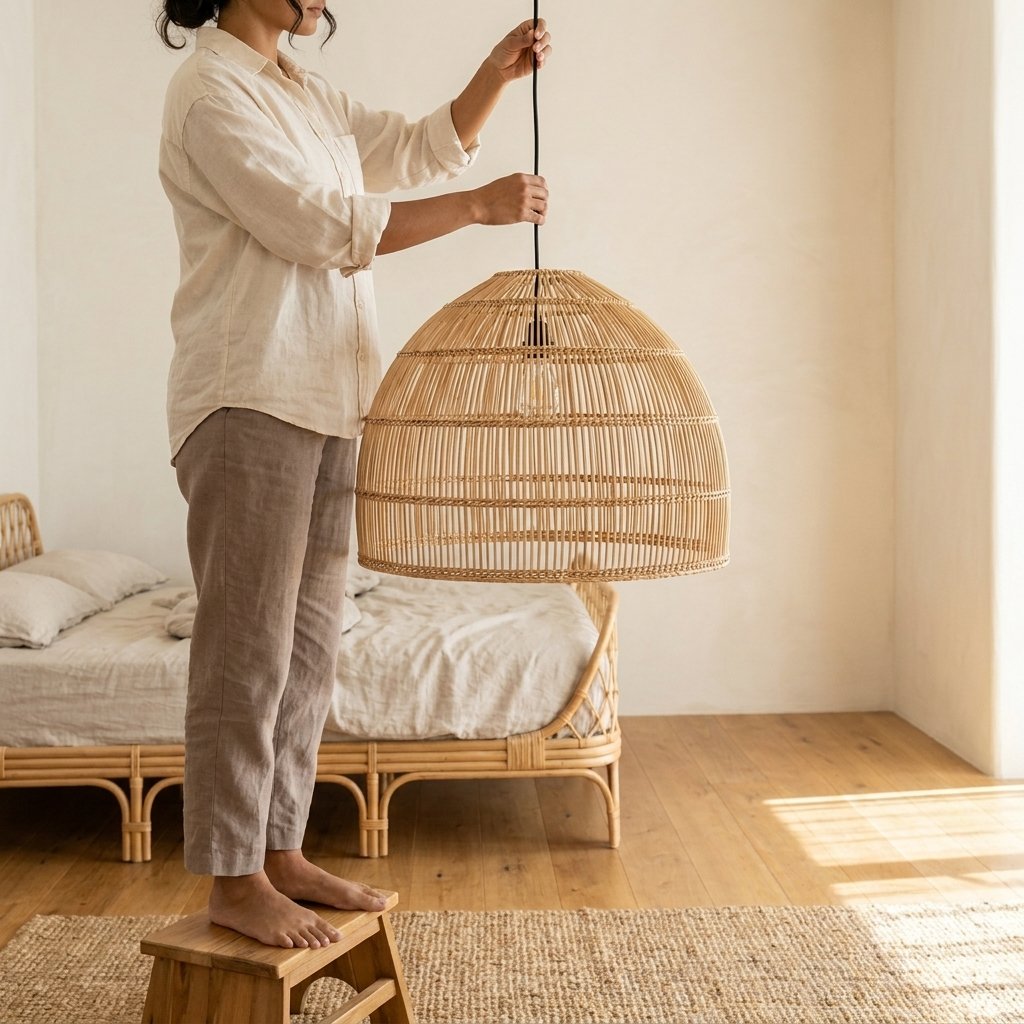
If there’s a single upgrade that transforms a bedroom from “bedroom” to “styled room,” it’s swapping out a generic ceiling light shade for a rattan pendant dome. It takes under 10 minutes and requires no tools beyond unscrewing your existing shade and replacing it.
How to do it:
- Turn off the ceiling light at the switch (not just the remote).
- Remove your existing lamp shade by unscrewing the finial or unhooking the shade clip.
- Thread your pendant cord through the top opening of the rattan shade.
- Re-attach the finial or clip inside the rattan dome to secure it.
- Turn the light back on and step back.
The warm light filtering through the woven rattan creates a beautiful dappled glow pattern on the ceiling — especially noticeable in the evenings.
Step 3 — Mount Your Macramé Wall Hanging
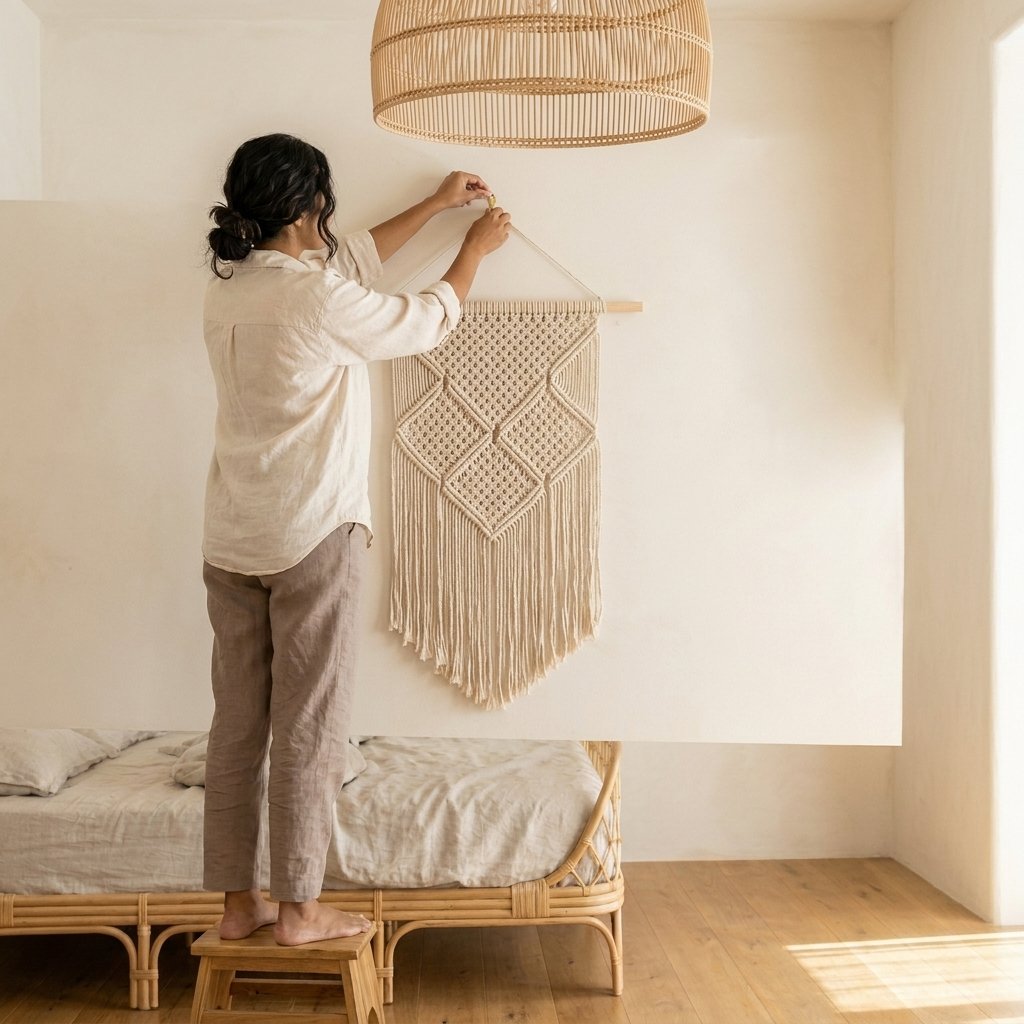
The macramé wall hanging is the signature piece of any boho bedroom. Centered above the bed is the most classic placement, but it also works beautifully on a bare side wall if your headboard wall already has a window or other feature.
Positioning guide:
- Height: The bottom of the macramé should sit roughly 8″–12″ above your pillow line when you’re lying in bed. Too high and it floats disconnected; too low and it gets lost behind pillows.
- Width: Ideally the macramé should span at least 50%–60% of your headboard’s width. A macramé that’s too narrow above a wide bed looks out of proportion.
- Hanging method: Most macramé comes with a wooden dowel rod at the top. A single brass picture hook rated for 20+ lbs is all you need. No drill required for most walls.
Styling tip: If you don’t want to put holes in your wall (renters, this one’s for you), use a large wooden decorative ladder leaned against the wall and drape your macramé over one of the rungs. It looks just as intentional and is completely damage-free.
Step 4 — Dress the Bed with Layers
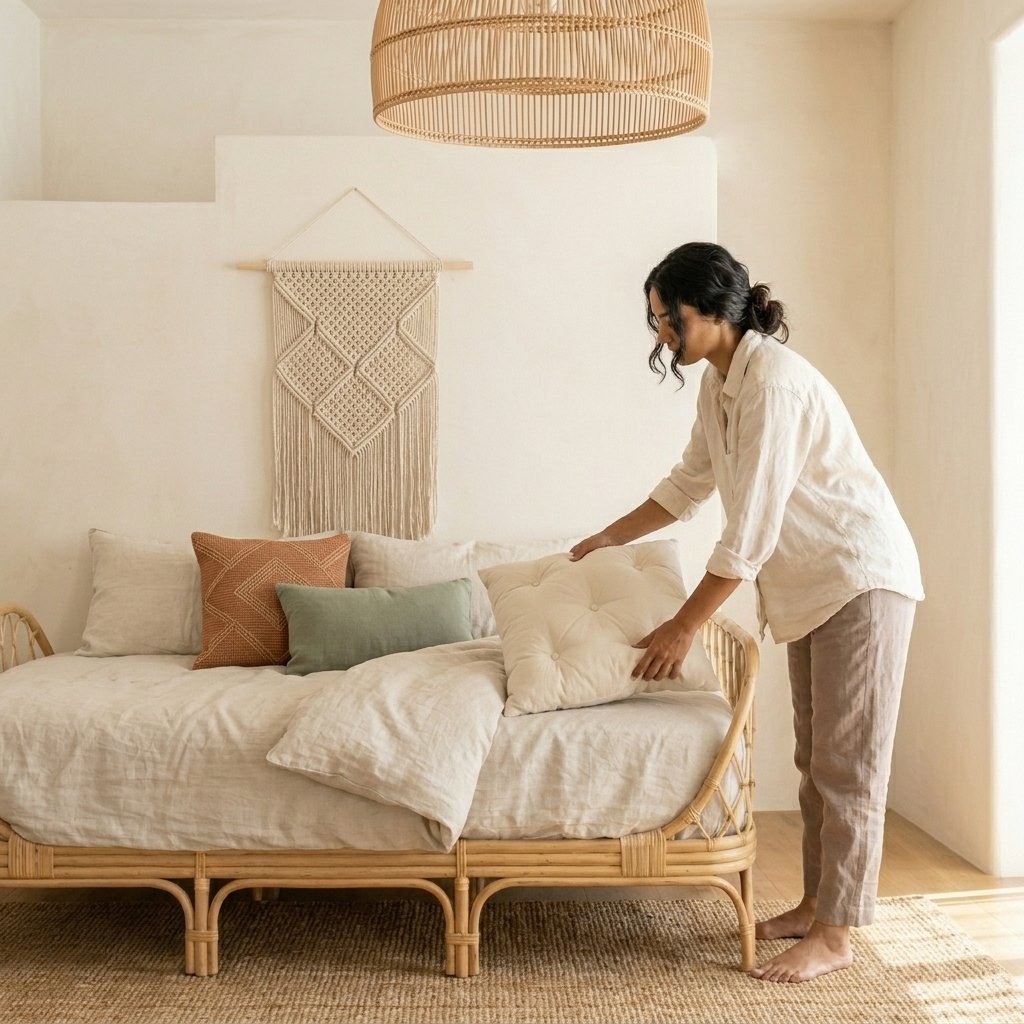
The bed is the largest surface in the bedroom and the biggest visual anchor of the whole space. In a boho bedroom, the goal is layered and lived-in — not hotel-tight.
The four-layer bed formula:
Layer 1 — The Linen Duvet: Pull it up but don’t smooth it perfectly. A slight fold-back at the top and a gentle rumple in the middle is the goal. Overly neat bedding reads as corporate hotel; casual and settled reads as deliberately styled.
Layer 2 — The Sleeping Pillows: Two large pillows in natural white or oat linen cases, standing upright and slightly overlapping. The backdrop for everything that comes next.
Layer 3 — The Throw Pillows: This is where the texture layering happens. The formula that always works:
- Two large square pillows at the back in contrasting textures (one solid terracotta, one cream tufted)
- One medium rectangular pillow in the middle (sage green woven works beautifully)
- One long lumbar pillow at the very front
Layer 4 — The Chunky Knit Throw: Fold it loosely in thirds lengthwise and drape it diagonally across the bottom corner of the bed. Don’t center it symmetrically — the slight asymmetry is what makes it look styled rather than staged.
Step 5 — Style the Bedside Table
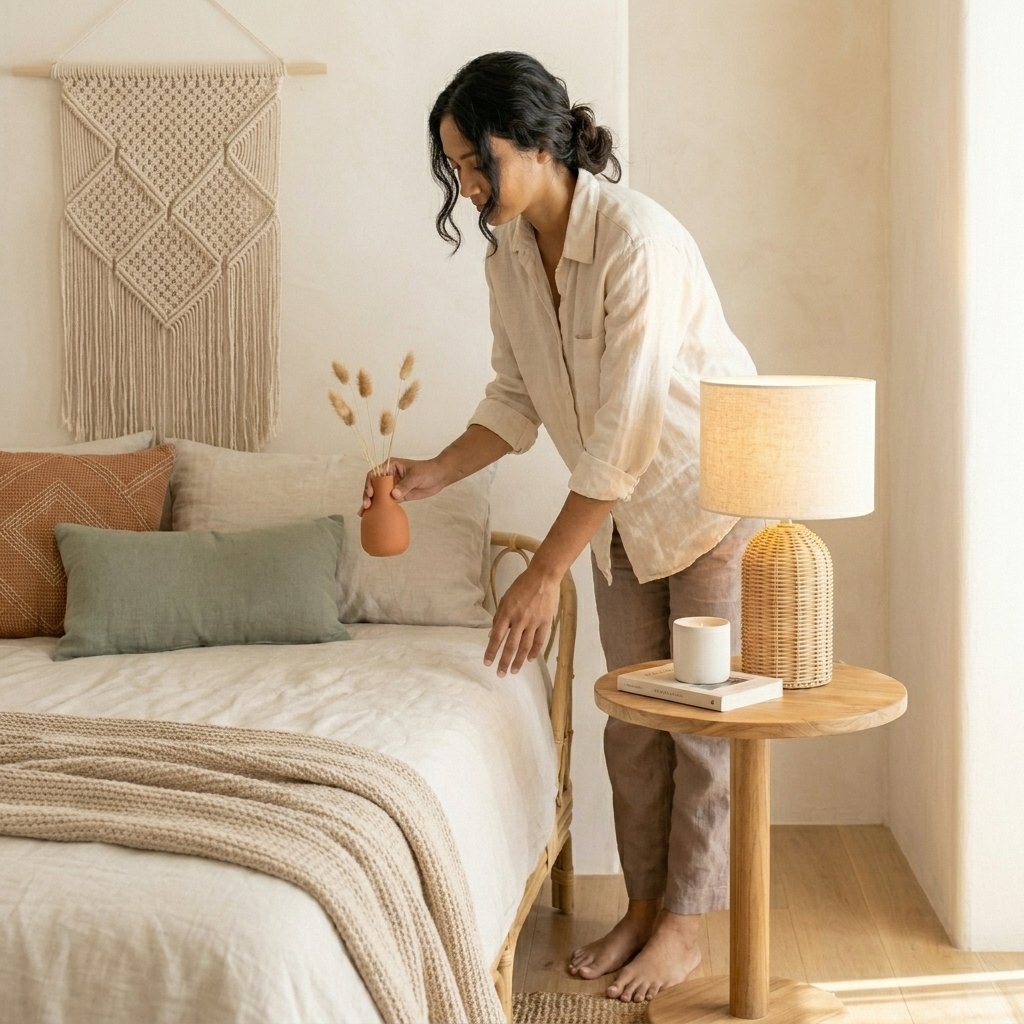
The bedside table is the room’s detail shot — it’s the vignette that appears in every bedroom inspiration photo and tells viewers “this room was thoughtfully styled, not just furnished.”
The boho bedside table formula (3 items maximum):
A boho bedside table works best with exactly three elements at different heights, creating a natural visual triangle:
Tall element: Your rattan table lamp. This is the tallest piece and the visual anchor of the vignette.
Medium element: A small terracotta or ceramic bud vase with 2–3 dried botanicals (bunny tail grass, dried lavender, or a single dried pampas stem). This sits at the midpoint of the visual triangle.
Low element: One or two slim paperback books stacked flat, or a small white ceramic candle holder, or a small crystal/stone — something with visual weight but very low profile.
The golden rule of boho vignettes: Everything on the surface should be touchable and functional, not purely decorative. A water glass, a candle you actually light, a book you’re actually reading — the “livedness” of these objects is what makes the vignette feel authentic rather than staged.
Step 6 — Create Your Pampas Grass Corner
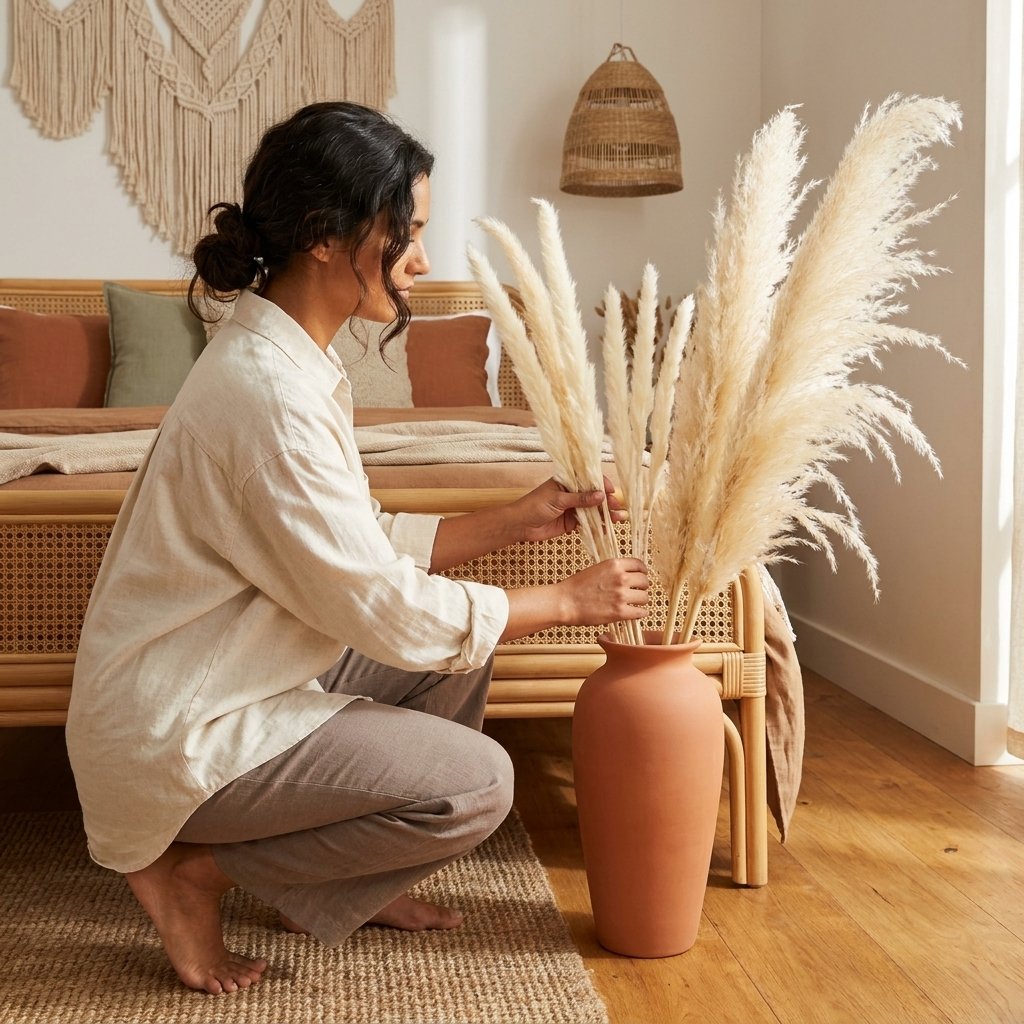
A tall pampas grass arrangement is to a boho bedroom what a statement necklace is to an outfit — it’s the one piece that makes everything else suddenly make sense. And it’s one of the easiest styling moves you can make.
How to arrange pampas grass in a vase:
- Choose your corner: Floor-level in the corner beside your bed or beside your dresser. Never on a shelf — pampas needs height and floor space to breathe.
- Prepare the vase: Fill the bottom third with dry sand or small pebbles (from your garden or a craft store) to weight the vase and keep it from tipping. Do not use water — pampas grass is dried and will rot in water.
- Build from the outside in: Place your tallest, most dramatic stems at the outermost positions first, angling them slightly outward. Then fill the center with slightly shorter stems. The goal is a loose, arching, organic arrangement — not a tight cylinder.
- Vary the heights: Cut 3–4 stems slightly shorter with scissors to create depth. Boho arrangements look best when not every stem is the same height.
- Let it move: Don’t over-arrange. Once stems are placed, resist the urge to keep fussing with them. The natural movement and slight asymmetry is exactly the look you want.

Care tip: Pampas grass will shed slightly, especially at first. A light spritz of hair spray or fabric sealant over the plumes when you first set them up dramatically reduces shedding and keeps them looking full for years.
Step 7 — Hang Your Trailing Plants and Add Fairy Lights
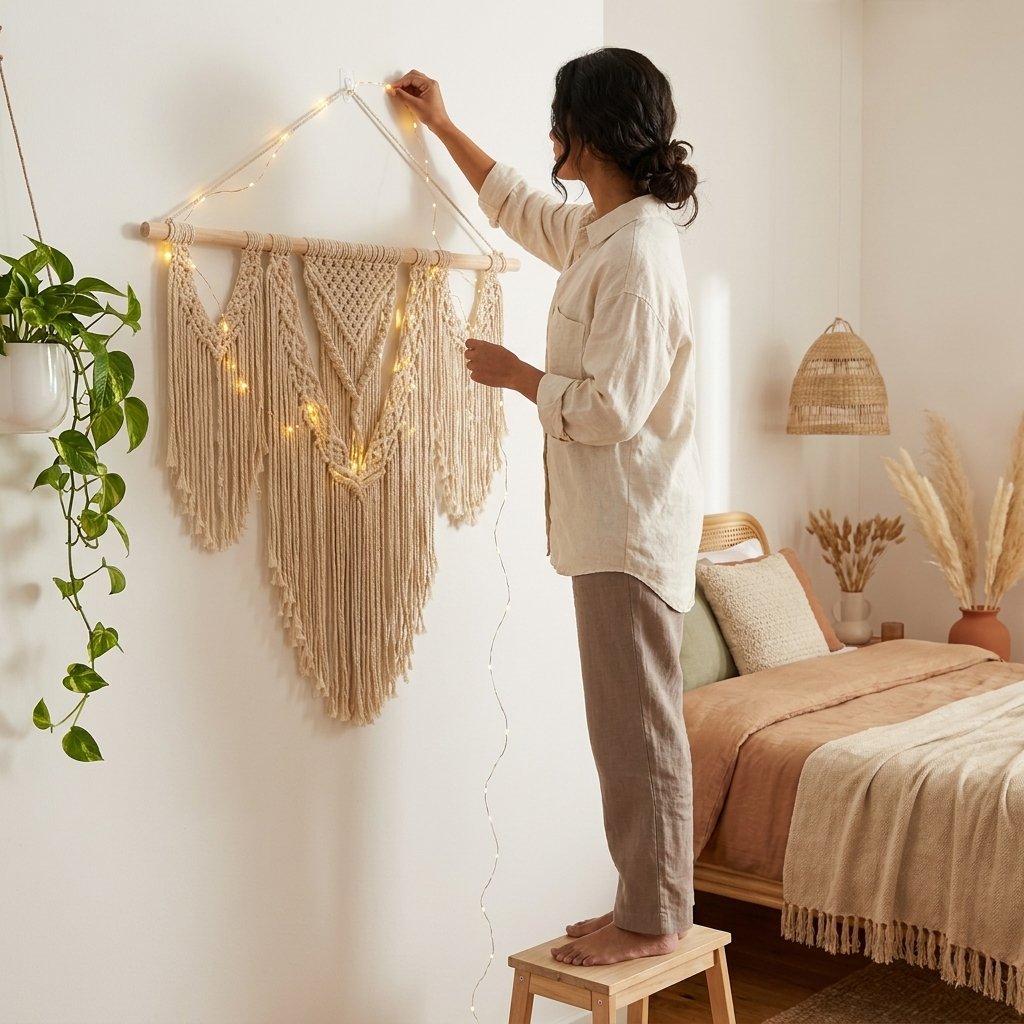
Fairy lights and hanging plants are the finishing touches that turn a well-decorated bedroom into a bedroom that glows. They add warmth and life in a way that no furniture or textile piece can replicate.
For the fairy lights: Drape them loosely — never tightly wrapped. The goal is a casual, organic cascade, not a neat border. Starting from one side of your macramé, loop the lights loosely through the rope knots and let them fall naturally at different depths. Use small clear adhesive hooks (Command strips work perfectly) to pin the cord against the wall at a few anchor points. Battery pack tucks behind the macramé’s dowel rod.
The transformation when you turn these on in the evening is one of the most satisfying moments of this whole project.
For the hanging plant: Install a single ceiling hook (a small screw hook rated for 10 lbs) above and to the left or right of your macramé — never directly above the bed. Hang your trailing pothos in a macramé plant hanger at a height where the longest trailing vines are roughly at shoulder level. Over time, pothos grow quickly and the trailing effect becomes more dramatic.
Step 8 — Add Storage Baskets and Final Styling
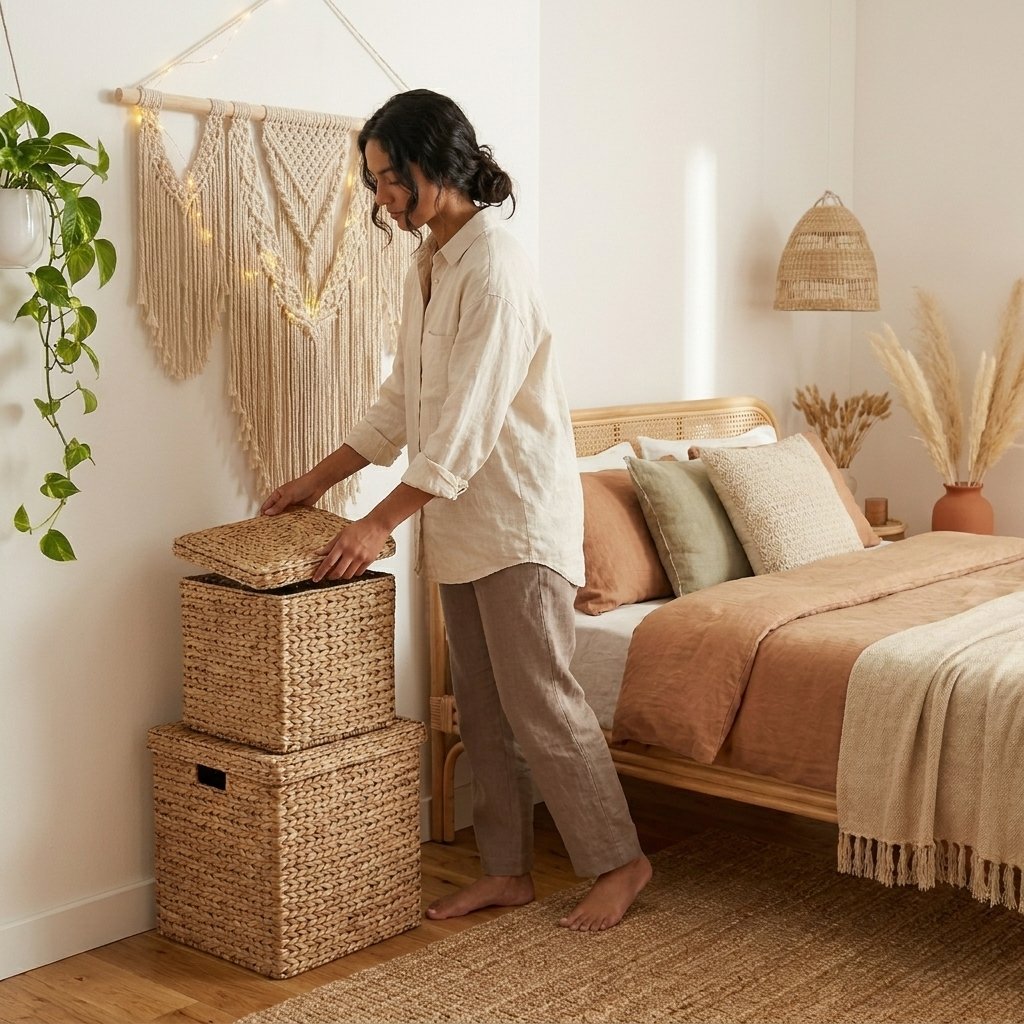
The final step is also one of the most underrated: storage that looks beautiful.
Two stacked seagrass baskets with lids in a bedroom corner serve a dual purpose that almost no other storage solution can: they hide the stuff you don’t want to see (extra blankets, charger cables, miscellaneous bedroom clutter) while actively adding to the boho aesthetic of the room. They look intentional. They look expensive. They cost less than $40 for a set of two.
Placement options:
- Floor beside the bed: The most natural placement — acts as both storage and a visual grounding element that balances the vertically-tall pampas arrangement on the other side.
- Under a window: If you have a bay window or window alcove, two stacked baskets underneath it are a classic boho vignette.
- In a corner: Tuck them into the corner diagonally opposite your bed for a layered, considered feel.
Final walk-through styling check: Once all pieces are in place, stand in the doorway of your bedroom and look at the whole picture. Ask yourself:
- Is there something at every height — floor, mid-level, and ceiling/wall?
- Are the textures varied (smooth, rough, woven, soft, dried)?
- Is the color palette warm and consistent — no stark bright colors that don’t belong?
- Does the room feel like someone lives here, or like a showroom?
If the answer to the last question is “showroom” — add one more personal element. A stack of actual books you’re reading. A candle you light every evening. A photograph in a simple frame. Boho style is always more personal than perfect.
Full Room Breakdown: The Complete Boho Bedroom Amazon Shopping List
Here’s everything consolidated, with price ranges, so you can shop in one go:
| Item | Est. Cost |
|---|---|
| Natural Jute Area Rug (8’×10′) | $28–$50 |
| Rattan Pendant Lamp Shade | $22–$48 |
| Large Macramé Wall Hanging | $18–$45 |
| Linen Duvet Cover (Queen) | $35–$50 |
| Boho Throw Pillow Covers (Set of 4) | $18–$36 |
| Chunky Knit Throw Blanket | $22–$42 |
| Dried Pampas Grass Bundle | $12–$22 |
| Dried Bunny Tail Grass | $8–$15 |
| Warm White Copper Fairy Lights | $8–$16 |
| Rattan Bedside Table Lamp | $28–$48 |
| Round Wooden Bedside Table | $32–$50 |
| Natural Seagrass Baskets (Set of 2) | $18–$38 |
| Macramé Plant Hanger | $8–$18 |
| Trailing Pothos Hanging Planter | $14–$28 |
| Terracotta Vase (Tall) | $12–$24 |
| Estimated Total | $291–$530 |
Important context on the total: You almost certainly don’t need all 15 items. If you’re starting from a furnished bedroom and just want to layer in the boho aesthetic, the highest-impact items per dollar spent are:
Tier 1 (Maximum impact, minimum spend — start here): Macramé wall hanging + rattan pendant shade + pampas grass + fairy lights = roughly $60–$130 total, transforms the room’s entire character.
Tier 2 (Elevate the bedding zone): Throw pillow cover set + chunky knit throw = roughly $40–$80, makes the bed look magazine-worthy.
Tier 3 (Complete the room): Jute rug + seagrass baskets + small bedside lamp = roughly $68–$136, grounds and finishes the whole space.
Boho Bedroom Styling Tips by Room Size: Style a Boho Bedroom with Amazon Finds
Boho styling principles are universal, but application varies by room size:
Small Bedroom (under 120 sq ft): Resist the urge to overcrowd. In a small room, one large macramé (not two), one pampas arrangement (not three), and a carefully curated bedside table is more impactful than filling every surface. Use vertical height aggressively — a tall macramé, a hanging plant, and a statement pendant light draw the eye up and make the room feel larger.
Medium Bedroom (120–200 sq ft): This is the sweet spot for boho layering. The full shopping list above is designed for this size. Layer generously and don’t hold back on textiles.
Large Bedroom (over 200 sq ft): Scale up. One large macramé may not be enough for a wide headboard wall — consider flanking it with two smaller pieces or adding a woven tapestry on a second wall. Double up the pampas arrangement, and consider a second jute rug layered over the first for maximum texture depth.
The 5 Most Common Boho Bedroom Styling Mistakes
Even with all the right pieces, these avoidable errors make a room look cluttered rather than curated:
1. Too Many Patterns at Once Boho permits pattern mixing, but there’s a limit. The rule of thumb: no more than two strong patterns in the same visual zone. A geometric throw pillow and a macramé wall hanging in the same corner works; add a patterned duvet and a printed rug and it starts to compete.
2. Cold-Toned Lighting Nothing destroys a boho bedroom atmosphere faster than cool blue-white LED bulbs. Every light source in a boho bedroom should be warm white (2700K–3000K color temperature). Swap every bulb in the room. It costs $8 and changes the entire feeling of the space.
3. Symmetry Everywhere Boho is an asymmetric aesthetic. Matching lamps on matching nightstands with matching pillows and matching vases is the language of contemporary or Scandinavian minimalism — not bohemian. In a boho bedroom, one bedside table is fine. One lamp is perfect. Mismatched pillow textures are the goal.
4. Neglecting the Floor A beautiful boho bedroom with no rug feels cold and unfinished. The jute rug is the single most impactful element after the macramé — don’t treat it as optional.
5. Forgetting Scent This is the one styling element that photography can’t capture but real humans experience. A candle or reed diffuser in a warm, natural scent (sandalwood, cedarwood, patchouli, amber) completes the sensory atmosphere of a boho bedroom in a way no visual element can replace.
Save This, Share This, Pin This on Pinterest
If you’ve made it to the end of this guide, you now have everything you need to completely transform your bedroom into a beautifully styled boho space — with Amazon finds, every piece under $50, and a step-by-step process you can follow in a single weekend afternoon.
The best part isn’t the finished bedroom photo (although that’s extremely satisfying). It’s the moment you walk through your bedroom door on a Sunday evening, turn on the rattan lamp and the fairy lights, smell your candle, and feel genuinely at home in a space you made beautiful yourself.
Related Post: DIY Doily Old Lampshade Makeover Using Thrifted Lace
Frequently Asked Questions
- What exactly does “boho” or “bohemian” mean as an interior style?
Bohemian interior style, commonly shortened to boho, draws its aesthetic from the 19th-century European Bohemian movement — artists, writers, and travelers who rejected conventionality and embraced an eclectic, travel-inspired, globally-influenced way of living. In modern interior design, it translates to rooms that layer natural textures, handcrafted objects, globally-inspired patterns, warm earthy tones, and living botanicals in a way that feels personally curated rather than catalog-coordinated. Boho style celebrates imperfection, warmth, and the sense that a room has been collected over time rather than purchased all at once. It is perhaps the most forgiving aesthetic in interior design — there are very few strict rules, which makes it extremely accessible for renters, beginners, and anyone working with a limited budget.
- Can I really make a bedroom look boho for under $50 total?
For a single statement upgrade — yes, absolutely. A large macramé wall hanging ($18–$35) hung above a bed instantly shifts the entire room’s character. A rattan pendant shade swap ($22–$45) changes the atmosphere completely. A bundle of pampas grass in a terracotta vase ($12–$22 combined) creates a dramatic organic statement. If you’re starting from scratch and want the full layered boho bedroom from floor to ceiling, a realistic budget is $150–$350 depending on room size, what you already own, and how many layers you want to add. The “under $50” refers to individual items — every item in the shopping list in this tutorial is available on Amazon for under $50 each. Shoppers in the UK, Australia, and Canada will find very similar price points (£35–£45, AUD $55–$75 equivalents) through their regional Amazon storefronts.
- Which single item has the biggest impact in a boho bedroom?
The macramé wall hanging, without question, is the single item that most reliably transforms a bedroom into a boho bedroom. It’s a statement piece that works at every budget level, works above any style of bed frame, and works in every room size. If you can only buy one item from this entire list, make it the macramé. Second place goes to the rattan pendant lamp shade — the effect of warm light filtering through woven rattan in the evening is genuinely dramatic and transforms the room’s mood completely.
- Does the boho style work in a small bedroom?
Boho works particularly well in small bedrooms because its emphasis on vertical elements — macramé wall hangings, hanging plants, tall pampas arrangements, pendant lighting — draws the eye upward, making small rooms feel larger. The key adjustments for small spaces are: choose one statement piece per wall rather than layering several; opt for a lighter color palette (more cream and sage, less heavily patterned); use mirrors strategically to reflect natural light and create the illusion of more space; and edit ruthlessly — a small boho bedroom with five carefully chosen pieces looks far better than the same room overcrowded with fifteen items.
- How do I style a boho bedroom if I’m a renter who can’t put holes in walls?
This is one of the most common questions, and the good news is that boho style is one of the most renter-adaptable aesthetics. For wall hangings: use 3M Command strips rated for 5+ lbs for lightweight macramé, or lean a decorative wooden ladder against the wall and drape macramé over its rungs. For pendant lights: if you can’t modify the ceiling fixture, a rattan floor lamp beside the bed achieves a very similar effect. For plants: use a standing plant stand or a tall shelf rather than ceiling hooks. For rugs and textiles: these all require zero wall involvement. The two things that make the biggest rental-friendly boho impact — macramé and pampas grass — both work perfectly without a single hole in any surface.
- What’s the best color palette for a boho bedroom?
The classic boho color palette centers on warm, desaturated, earthy tones: natural oat and cream (the base neutrals), terracotta and rust (warm accent colors), sage green and dusty olive (organic accent colors), and mustard or warm sand (optional contrast). The overall effect should feel warm, sun-baked, and organic — never cold, stark, or neon. A simple test: if a color exists in nature without human intervention (the color of dry clay, dried grass, a sage plant, warm sand, a sunset), it belongs in a boho bedroom. If it looks like it was created in a lab (neon, electric blue, hot pink), it doesn’t. That said, boho style does welcome unexpected pops of color — a deep jewel tone like teal or burgundy used sparingly as an accent reads as intentionally global and eclectic.
- How do I keep pampas grass from shedding everywhere?
Fresh-from-the-package pampas grass will shed fine filaments, especially in the first few days. The most effective solution is to lightly mist the entire plume arrangement with a thin coat of hair spray (any brand, any hold strength) or a dedicated fabric sealant spray immediately after arranging. This slightly dampens the filaments and causes them to bond to each other, dramatically reducing shedding. Let it dry completely before touching the stems again. Repeat once every three to four months, or whenever you notice shedding resuming. Avoid placing your pampas arrangement directly under an air conditioning or heating vent — the constant airflow causes significantly more shedding than the spray can compensate for.
- What type of rug works best for a boho bedroom?
Natural jute is the most universally recommended boho bedroom rug material because its warm honey-brown color works with virtually every boho color palette, its chunky natural texture adds depth, it’s durable underfoot, and it’s one of the most affordable natural fiber rug options available. Second choice is a natural seagrass or sisal rug — similar look, slightly more tightly woven and easier to clean. Third choice is a flat-weave cotton rug in a Moroccan or tribal geometric pattern — adds pattern interest and is extremely lightweight and easy to clean. What to avoid: fluffy high-pile rugs (they trap pampas grass shedding and collect pet hair), synthetic shaggy rugs (they look and feel plasticky), and cool-toned grey or blue-grey rugs (they work against the warm boho palette).
- How do I choose the right size macramé wall hanging for my bedroom?
The most common mistake is choosing a macramé that’s too small for the wall. As a rule of thumb, your macramé should span at least 50%–60% of your headboard width, and ideally 70%–80% for a full statement. For a standard queen-size headboard (60″ wide), look for a macramé that is at least 30″–40″ wide. For a king-size headboard (76″ wide), aim for 40″–55″ wide. The height matters too: a piece with long fringe that extends 36″–48″ from dowel to fringe tip feels generous and dramatic; anything shorter can feel like an accessory rather than a statement. When in doubt, size up — a macramé that feels slightly too large in the product photo will almost always look exactly right on your wall.
- Are Amazon boho home decor items actually good quality?
This varies significantly by product category, and it’s worth being specific. Macramé wall hangings from Amazon range from genuinely beautiful (natural cotton rope, well-knotted, sturdy dowels) to thin and flimsy — read reviews carefully and look for listings that show the rope thickness clearly in photos. Rattan lamp shades are consistently good quality across most Amazon listings — rattan is a durable natural material and the construction is simple. Dried botanicals (pampas grass, bunny tail grass) are uniformly good quality since they’re simply dried plant stems. Bedding quality varies most — prioritize listings that specify 100% linen or a high linen percentage rather than “linen-look” polyester blends, which don’t drape or photograph as well. Woven baskets are reliably good. The key habit: always sort by “Average Customer Review” and read the top critical reviews before purchasing any item over $20.
- How do I incorporate boho bedroom style without it looking messy or cluttered?
The distinction between “curated boho” and “cluttered chaos” comes down to three principles. First, maintain a consistent color palette — when every item, even if it has a different texture and pattern, shares the same warm earthy color family, the room reads as intentional rather than random. Second, give every item space to breathe — items crammed together compete for attention; items with visible space between them each get their own moment to be appreciated. Third, have one hero piece per zone: one statement on the wall (the macramé), one statement on the floor (the pampas arrangement), one statement on the bed (the layered pillows), one statement on the bedside (the styled vignette). When each zone has one clear focal point and supporting cast, the room feels curated even when it’s full of different pieces.
- Can I mix boho with other design styles?
Absolutely — boho is one of the most versatile styles for mixing and it’s rarely done in pure form. “Boho-minimalist” combines the natural textures and botanicals of boho with the restraint and whitespace of minimalism — fewer pieces, more carefully chosen. “Coastal boho” layers the natural materials of boho with light blues, whites, and ocean-inspired accents. “Boho-glam” pairs the handcrafted textiles of boho with metallic gold accents, velvet pillows, and a more curated luxury feel. “Boho-Scandinavian” (sometimes called Scandi-boho or Sboho) pairs the natural materials of bohemian style with the functionality and light palette of Scandinavian design. The gold leaf accent wall tutorial in this blog’s sister post is a perfect example of boho-glam — proof that the two aesthetics can live beautifully in the same bedroom.
- How do I add boho style to a bedroom with existing furniture I can’t replace?
The furniture itself matters far less than the textiles and decorative layers placed on and around it. A very standard IKEA Malm dresser with a macramé wall hanging above it, a small rattan lamp on top, a trailing plant cascading off the corner, and a small terracotta vase with dried botanicals reads as fully boho. The furniture becomes the backdrop, not the statement. The same principle applies to beds, wardrobes, and desks — the textiles, botanicals, and handcrafted pieces you layer around them do far more visual work than the furniture itself. This is actually one of boho’s great advantages over styles like mid-century modern or Scandinavian minimalism, which require specific furniture silhouettes to work correctly.
- How long does it take to style a boho bedroom from scratch?
If you have all your pieces delivered and ready to go, a single-room boho bedroom styling from scratch — rug placement through final bedside vignette — takes approximately two to four hours. The steps that take the longest are hanging the macramé (15–30 minutes including finding center and ensuring it’s level), arranging the pampas grass to your satisfaction (10–20 minutes), and layering the bedding correctly (15–25 minutes). Everything else — the lamp shade swap, fairy lights, basket placement, plant hanging — takes 5–10 minutes each. The good news is that none of it requires tools beyond a hammer, a step stool, and scissors. It’s an entirely achievable weekend afternoon project.
- Is the boho aesthetic still in style, or has it peaked?
As of 2025–2026, the core bohemian aesthetic shows no sign of declining in popularity on Pinterest, Instagram, or in mainstream home retail. What has evolved is the expression of boho style — the maximalist, heavily patterned, everything-at-once version of boho that peaked around 2018–2020 has given way to a more edited, refined approach sometimes called “modern boho” or “elevated boho.” This version keeps the natural materials, warm textures, and organic botanicals but pairs them with a more restrained color palette and more intentional curation — fewer pieces, better quality, more breathing room. The items featured in this tutorial are squarely in the modern boho direction, which interior trend analysts consistently project to remain popular well into the late 2020s given the continued cultural appetite for warmth, naturalism, and handcrafted aesthetics as a counterbalance to digital-heavy modern life.
- What’s the difference between boho and farmhouse style?
They look similar online. They share some common ground — both use natural materials, neutral palettes, and handcrafted aesthetics — but the philosophy and feeling are quite different. Farmhouse style is structured, symmetrical, rooted in American rural tradition, and favors shiplap walls, galvanized metal, distressed white paint, and a tidier, more organized look. Boho style is global, asymmetric, layered, and rooted in travel and cultural eclecticism — it favors Moroccan-inspired patterns, global textiles, trailing plants, and a more artistic, personal, and deliberately imperfect feel. On Pinterest you’ll often see both labeled together as “boho farmhouse” or “rustic boho,” which is a hybrid that takes the neutral palette and natural materials of both and blends them into a single aesthetic. This tutorial leans pure boho — if you want to drift toward the farmhouse direction, swap the terracotta tones for more weathered white, remove the macramé, and add some simple shiplap-inspired wall paneling.