As an Amazon Associate we earn from qualifying purchases. Here’s how it works.
Fresh basil beside the stove sounds idyllic. Remembering to water it, finding enough sunlight, dealing with soil on the counter and watching half the plant give up two weeks later? Less idyllic.
That is why indoor smart gardens have become such an interesting middle ground between a kitchen appliance and a miniature edible garden.
The best countertop systems combine an LED grow light, water reservoir and some level of automated plant care in a footprint small enough for a kitchen, apartment or home office. Some are true hydroponic gardens with circulating nutrient solution. Others use self-watering growing media that remove almost all of the measuring and mixing.
They are not miniature farms, and a six- or twelve-pod garden will not replace your weekly produce shop. What they can do surprisingly well is keep frequently used herbs, lettuces and compact greens within reach year-round.
That also fits into a much bigger shift toward bringing nature into the home. Our Biophilic Design Statistics & Research report looks at the evidence behind greenery, natural light and nature-connected interiors in more detail. A countertop garden is one practical way to bring living plants into a kitchen or small space without needing a backyard.
For 2027, these are the indoor gardens we would shortlist first.
The Best Indoor Smart Gardens for 2027 at a Glance
| Indoor garden | Best for | Capacity | Standout feature |
|---|---|---|---|
| LETPOT LPH-Max | Best overall premium system | 21 standard pods + 2 large planting positions | Automatic water and nutrient management |
| LETPOT LPH-SE | Best 12-pod smart system | 12 pods | App control + tall adjustable light |
| Click & Grow Smart Garden 9 | Best low-maintenance system | 9 pods | Silent passive watering |
| iDOO 12-Pod Hydroponics Growing System | Best value for most homes | 12 pods | Strong capacity-to-price balance |
| Spider Farmer SmartG12 | Best for stronger lighting | 12 pods | 36W grow light + 6L reservoir |
| Ahopegarden 12-Pod Smart Garden | Best budget 12-pod system | 12 pods | Simple controls and compact footprint |
| inbloom 12-Pod Hydroponics Growing System | Best low-water warning system | 12 pods | Dedicated water-shortage alarm |
| URUQ 8-Pod Hydroponics Growing System | Best quiet compact pick | 8 pods | Very quiet pump + tall light adjustment |
| MUFGA 18-Pod Hydroponics Growing System | Best high-capacity budget pick | 18 pods | Lots of growing positions for the money |
| LETPOT LPH-Air | Best affordable Wi-Fi garden | 10 pods | App control at a lower price tier |
| Click & Grow Smart Garden 3 | Best for tiny spaces | 3 pods | Ultra-simple, silent operation |
What We Look for in a Countertop Smart Garden?
This guide is based on current manufacturer specifications, system design, support status, growing capacity, reservoir size, lighting, automation, replacement-supply flexibility and how each system fits a particular type of buyer.
Not every system on this list has been independently hands-on tested by Luxe Home Decors, so we do not pretend that it has.
For a countertop garden to make this list, it needed to solve at least one real buying problem well: limited counter space, high maintenance, pump noise, app control, taller plants, large capacity, beginner-friendly growing or value.
The number of pod holes alone matters less than it appears.
Twelve planting positions sound better than eight, but a mature basil plant can easily shade several neighboring seedlings. Light height, reservoir capacity, spacing and ease of cleaning can matter more in everyday use.
With that in mind, here are the systems worth comparing.
1. LETPOT LPH-Max — Best Overall Indoor Smart Garden
Best for: buyers who want the most automation from a countertop system
The LETPOT LPH-Max is the system we would put at the top of the list for someone who wants a serious indoor garden but still wants it to behave more like an appliance than a hobby.
It supports 21 standard planting positions plus a separate two-hole tray for larger plants, uses a 7.5-liter water reservoir, a 36W grow light, and a light assembly that can rise to approximately 30 inches. Most importantly, it goes beyond basic timers: the system supports automatic water replenishment and automatic nutrient dosing, along with control through its built-in screen and companion app.

That extra automation is where the LPH-Max separates itself from cheaper countertop gardens.
Most systems automate lighting and water circulation but still require you to monitor the reservoir and measure nutrients manually. The Max is aimed at buyers who want fewer intervention points, particularly when growing several plants simultaneously.
The generous light height also makes it a better candidate for basil, taller herbs and carefully managed compact fruiting varieties than short systems that quickly run out of vertical clearance.
What we like about it? – The combination of capacity, app control, large reservoir and automated nutrient handling makes this one of the most complete countertop systems currently available.
It is also an open growing system rather than a garden that requires one brand’s pre-seeded plant capsules. That gives you more freedom to experiment with your own basil, lettuce, parsley, dill, bok choy and other seeds.
What to know before buying? – Twenty-one planting holes do not mean you should grow 21 full-size basil or tomato plants at once.
Large plants need breathing room.
For a productive setup, we would use more positions for small leafy greens and herbs, while leaving empty spaces around anything likely to become tall or wide.
Best plants for it – Basil, parsley, cilantro, lettuce, arugula, bok choy, mint, dill and compact peppers or tomatoes with adequate spacing.
Verdict: If convenience matters more than keeping the initial cost as low as possible, this is the strongest all-round system in the list.
2. LETPOT LPH-SE — Best 12-Pod Smart Garden
Best for: buyers who want premium smart features without moving to a 20-plus-pod system
The LETPOT LPH-SE is a particularly good middle ground.
You get 12 planting positions, a 5.5L reservoir, 24W full-spectrum lighting, app and touch controls, plus a light assembly that can extend significantly higher than many budget countertop gardens. The current version also uses a stainless-steel exterior rather than the all-plastic finish common in the category.

For a normal kitchen, twelve positions are arguably easier to use than twenty-one anyway.
You have enough capacity to grow a useful herb rotation without letting the garden completely take over the counter.
The 30-inch maximum light height is particularly interesting because vertical clearance is one of the hidden weaknesses of cheaper indoor gardens. Basil can become surprisingly tall, and compact pepper or tomato plants need significantly more room than lettuce.
Why choose it over the LPH-Max?
Choose the SE if you want:
- a smaller footprint;
- lower initial cost;
- twelve plants rather than twenty-plus;
- app control;
- a premium-looking body;
- generous vertical adjustment.
Choose the Max instead if automatic refilling and automatic nutrient dosing are major priorities.
Best plants for it
Basil, cilantro, parsley, mint, chives, leafy lettuce, kale, bok choy and compact fruiting plants.
Verdict: Probably the sweet spot for buyers who want a genuinely “smart” countertop garden without paying for maximum capacity.
3. Click & Grow Smart Garden 9 — Best for Low-Maintenance Growing
Best for: beginners who want the least complicated experience possible
Not everyone wants to measure nutrients, hear a pump or think about hydroponic water chemistry.
That is where the Click & Grow Smart Garden 9 makes sense.
It holds nine plant pods, uses a 4-liter water tank, consumes about 13W, and relies on passive wick-based watering rather than an active circulation pump. Its automated light runs on a 16-hour-on, 8-hour-off cycle. The manufacturer says the reservoir can last for up to three weeks depending on plant conditions.

Because there is no water pump, this is also one of the easiest systems to place in an open-plan kitchen, studio apartment or quiet home office.
The tradeoff is that Click & Grow works differently from conventional hydroponic gardens. It is designed around the company’s pre-seeded growing pods and wicking medium. That is extremely convenient, but replacement pods create a recurring cost.
Who should buy it?
This is the garden we would point toward someone who says:
“We want fresh herbs, but we absolutely do not want indoor gardening to become another hobby.”
Insert pod. Add water. Plug it in. Harvest later.
That simplicity is the entire selling point.
Best plants for it – Basil, lettuce, cilantro, thyme, chives, mint and compact tomatoes from compatible plant pods.
Verdict: One of the strongest options for people who value convenience and good countertop design more than maximum growing flexibility.
4. iDOO 12-Pod Hydroponics Growing System — Best Value for Most Homes
Best for: buyers who want plenty of growing capacity without paying premium-system prices
The iDOO 12-Pod Hydroponics Growing System has become one of the most recognizable value picks in this category.
Current versions commonly pair 12 growing positions with a 4.5L tank and a 22W LED grow light, plus circulation and adjustable lighting for herbs and greens.

What makes this type of system appealing is that it gives you most of what actually matters—light, water circulation, twelve growing positions and adjustable height—without requiring premium automation.
For someone trying countertop hydroponics for the first time, that can be a smarter purchase than immediately jumping to the most expensive system available.
Where it makes sense? – Think practical kitchen herb garden rather than showpiece appliance.
A rotation of basil, parsley, dill, lettuce and cilantro is exactly the type of use case where a 12-pod garden earns its space.
Where it falls behind? – You give up some of the deeper app integration and automation available on systems such as the LETPOT models.
The shorter vertical envelope on many iDOO versions can also make aggressive pruning more important as basil and other tall plants mature.
Best plants for it – Leaf lettuce, basil, cilantro, parsley, dill, chives and smaller greens.
Verdict: A strong starting point for someone who wants real hydroponic capacity while keeping the purchase relatively sensible.
5. Spider Farmer SmartG12 — Best for Stronger Lighting
Best for: buyers who care about light output and want room for taller growth
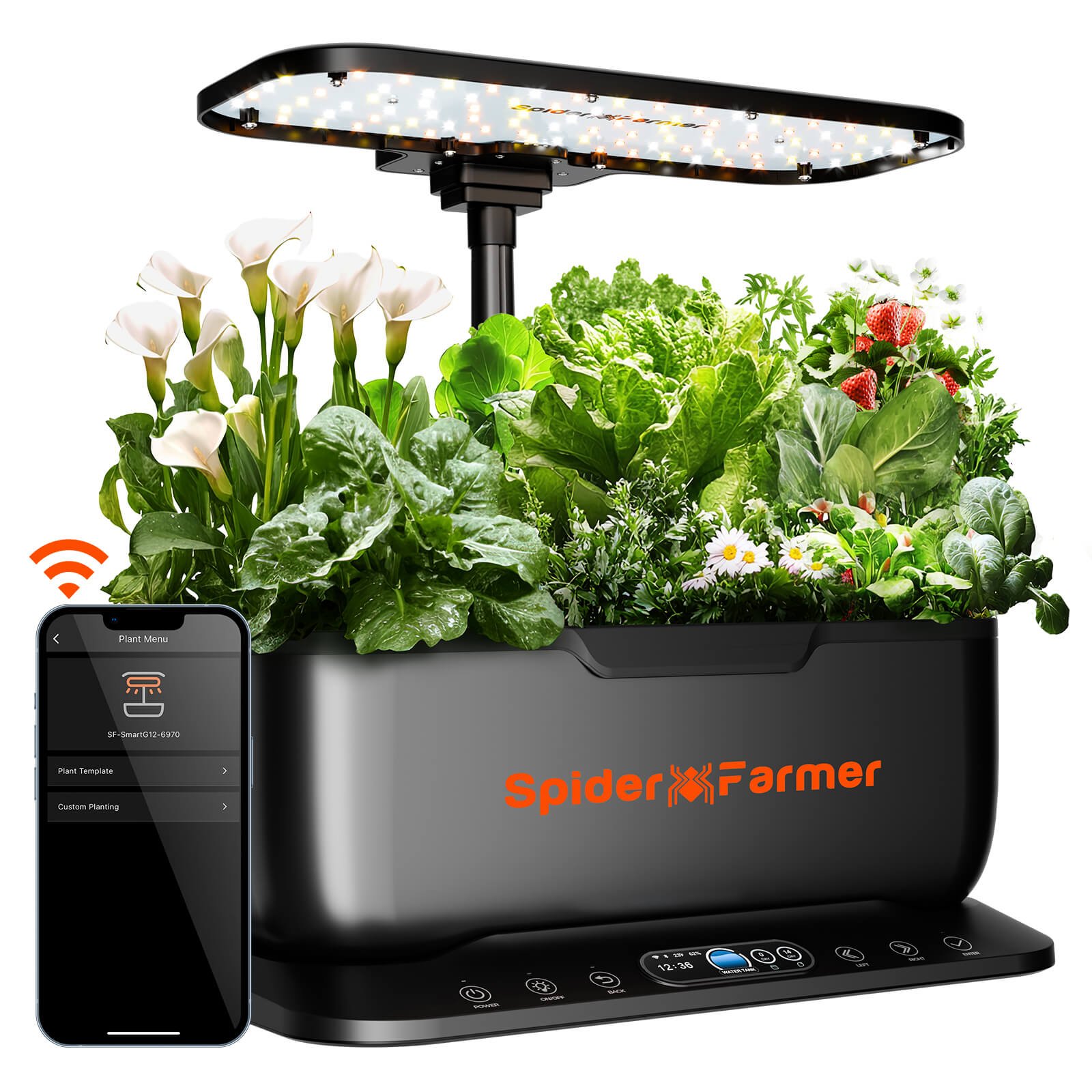
The Spider Farmer SmartG12 combines 12 planting positions, a 6L reservoir and a 36W full-spectrum LED with Wi-Fi/app control and programmable lighting.
Its current specification also gives plants considerably more vertical room than many low-cost countertop kits.
Lighting is one of the areas where countertop gardens are easiest to underestimate.
Seedlings do not need the same canopy clearance as mature basil, peppers or tomatoes, and a lamp that works perfectly during week two can become restrictive by week eight.
The SmartG12 is therefore attractive if you want a system that gives you more room to experiment beyond a few small herbs.
Why we would choose it? – The 36W light, larger reservoir and app-connected controls make it more serious than many basic plug-and-grow kits without pushing into a large floor-standing garden.
The tradeoff – A brighter, larger system makes a bigger visual statement in your kitchen.
If the garden will sit beside the dining table or in a studio apartment, consider where that grow light will point during its daily lighting cycle.
Best plants for it – Basil, leafy greens, kale, bok choy, dwarf peppers and carefully managed compact tomatoes.
Verdict: A compelling option if light output and vertical flexibility matter more than having the smallest possible footprint.
6. Ahopegarden 12-Pod Smart Garden — Best Budget 12-Pod Pick
Best for: beginners who want straightforward hydroponics and a low barrier to entry
The Ahopegarden 12-Pod Smart Garden is the type of system that makes countertop hydroponics easy to try without turning it into a major purchase.
The current standard model supports 12 growing positions, adjustable lighting, vegetable and flower/fruit-oriented modes, water circulation and multiple light-cycle options.

That is important because similarly named indoor gardens can have different reservoir sizes and control panels.
Why it works for beginners? – It covers the fundamentals without asking you to learn an app first.
Fill the reservoir, add nutrients, start seeds in the grow sponges and let the built-in light and water circulation handle most of the daily routine.
Best plants for it – Basil, parsley, chives, lettuce, spinach, arugula and other compact greens.
Verdict: One of the easiest ways to test whether countertop hydroponics actually fits your routine before spending significantly more.
7. inbloom 12-Pod Hydroponics Growing System — Best for Low-Water Alerts
Best for: anyone likely to forget that the reservoir exists
Indoor gardens automate a lot, but they still cannot grow plants without water.
The inbloom 12-Pod Hydroponics Growing System tries to solve that with a dedicated water-shortage warning. Current versions combine 12 planting positions, a 4.2L tank, 24W full-spectrum lighting and an alarm that activates as the reservoir approaches a low-water threshold.

That sounds like a small feature until you have mature basil and lettuce pulling water from a reservoir much faster than they did as seedlings.
Water consumption increases as plants grow, which means the refill pattern you learned in week two may no longer work in week eight.
Another advantage: light coverage
The system uses a relatively dense LED array positioned above the canopy, which makes it attractive for leafy greens and herbs where even coverage matters.
What to consider? – The light is bright.
That is useful for plants but potentially annoying if the garden sits directly in your line of sight in an open-plan apartment.
Best plants for it – Basil, lettuce, parsley, dill, chives, leafy greens and small herbs.
Verdict: A sensible choice for busy households where a low-water warning is more useful than another layer of app features.
8. URUQ 8-Pod Hydroponics Growing System — Best Quiet Compact Pick
Best for: studio apartments, desks, home offices and smaller kitchens
Some indoor gardens are technically quiet until you put them six feet from your sofa.
The URUQ 8-Pod Hydroponics Growing System is particularly interesting because current versions pair a 24W grow light, 3L reservoir and eight planting positions with a pump rated below 20 dB, along with a tall adjustable light assembly.

Eight pods can actually be an advantage in a small home.
You get more planting flexibility than a three-pod garden without dedicating as much counter space to the system as a large 12-, 18- or 21-pod unit.
Think about the room, not just the plant capacity – For an open kitchen, home office or studio, noise and light direction can matter as much as yield.
The URUQ’s adjustable light also helps you direct the panel during maintenance and accommodate growing herbs.
Best plants for it – Basil, parsley, mint, chives, lettuce and smaller herbs.
Verdict: A practical fit when counter space and background noise are bigger concerns than maximizing pod count.
9. MUFGA 18-Pod Hydroponics Growing System — Best High-Capacity Budget Pick
Best for: buyers who care more about planting capacity than app features
If your first instinct is:
“Why grow eight herbs when one could start eighteen?”
The MUFGA 18-Pod Hydroponics Growing System is worth looking at.
The system offers 18 growing positions and an adjustable light structure designed for countertop herbs and greens, with current listings showing a maximum light height around 17.7 inches.

The obvious appeal is capacity.
But use those 18 holes strategically rather than automatically filling every opening.
A bed of small lettuce plants can use relatively dense spacing. Six mature basil plants cannot.
A better planting strategy – Use the system for succession growing.
For example:
- several young lettuce plants;
- two or three basil plants;
- parsley;
- cilantro;
- dill;
- a few empty holes capped to reduce light entering the reservoir.
That can produce a much more useful kitchen garden than eighteen crowded plants fighting for the same canopy space.
Best plants for it – Lettuces, smaller leafy greens, basil seedlings, parsley, cilantro and herbs grown in staggered batches.
Verdict: The capacity play of the list—best for buyers who want lots of planting positions without paying for premium automation.
10. LETPOT LPH-Air — Best Affordable Wi-Fi Smart Garden
Best for: buyers who want app control without moving into the premium tier
The LETPOT LPH-Air is one of the more interesting value propositions in the current smart-garden market.
It provides 10 planting positions, a 24W full-spectrum light, 4L reservoir and Wi-Fi/app controls, including customizable lighting schedules and water-level notifications.

If you like the idea of the LPH-SE but do not need its larger tank, premium exterior or extra vertical range, the LPH-Air can make more sense.
Its narrower footprint also makes ten planting positions easier to accommodate in an ordinary kitchen.
Why the app matters? – Remote control is not essential to hydroponics.
What is genuinely useful is being able to adjust the light schedule so the LEDs are not blazing into your kitchen late at night, plus getting a reminder before the reservoir becomes too low.
That is the type of smart functionality that solves a real household problem.
Best plants for it – Basil, parsley, dill, cilantro, lettuce, arugula, bok choy and other compact greens.
Verdict: The value smart-home pick: enough connected functionality to be useful without requiring the most expensive hardware.
11. Click & Grow Smart Garden 3 — Best Indoor Garden for Tiny Spaces
Best for: apartments, narrow counters, gifts and people who only want a few herbs
Not everyone needs twelve herbs growing at the same time.
The Click & Grow Smart Garden 3 has room for only three plant pods, but that is precisely why it works so well in very small spaces.
It is approximately 12 inches wide, uses an 8W grow light, and has a compact self-watering reservoir. Like the larger Smart Garden 9, it relies on passive watering rather than a noisy circulation pump.

This is less a produce machine and more a living kitchen accessory.
Three slots are enough for something like:
basil + cilantro + chives
or:
basil + thyme + mint
without letting the garden become another countertop appliance you have to work around.
Why it also makes a good gift – There is very little setup to explain.
The included growing pods remove most of the uncertainty around nutrients, germination media and seed depth, while the automated lighting and passive watering handle the repetitive work.
The tradeoff is recurring plant-pod cost and limited growing capacity.
Best plants for it – Basil, thyme, mint, cilantro, chives and other compact herbs.
Verdict: Buy this because you want simplicity and a tiny footprint—not because you are trying to maximize harvest.
Which Indoor Smart Garden Should You Buy?
For most buyers, we would narrow the decision down by lifestyle rather than chasing the highest pod count.
If you want maximum automation, start with the LETPOT LPH-Max.
If you want the best balance between smart controls, countertop size and growing flexibility, look closely at the LETPOT LPH-SE.
If you want a simple garden that requires almost no technical learning, the Click & Grow Smart Garden 9 is easier to live with.
If budget matters more than app control, the iDOO 12-Pod and Ahopegarden 12-Pod systems make more sense.
For a quiet apartment or home office, look at the URUQ 8-Pod.
And if you barely have counter space to begin with, the Click & Grow Smart Garden 3 is probably the more realistic choice than forcing a 12-pod garden into your kitchen.
Do You Really Need 12 or 21 Pods?
Probably not.
Pod count is one of the most effective numbers for selling hydroponic gardens because bigger sounds better.
Plants do not care about marketing numbers.
A mature basil plant can easily spread over neighboring pod positions. Mint becomes aggressive. Tomatoes and peppers need substantially more room above and around them than baby lettuce.
For larger herbs, spacing plants apart often produces a better garden than filling every available hole.
If you primarily want lettuce or small greens, higher pod counts are easier to use efficiently.
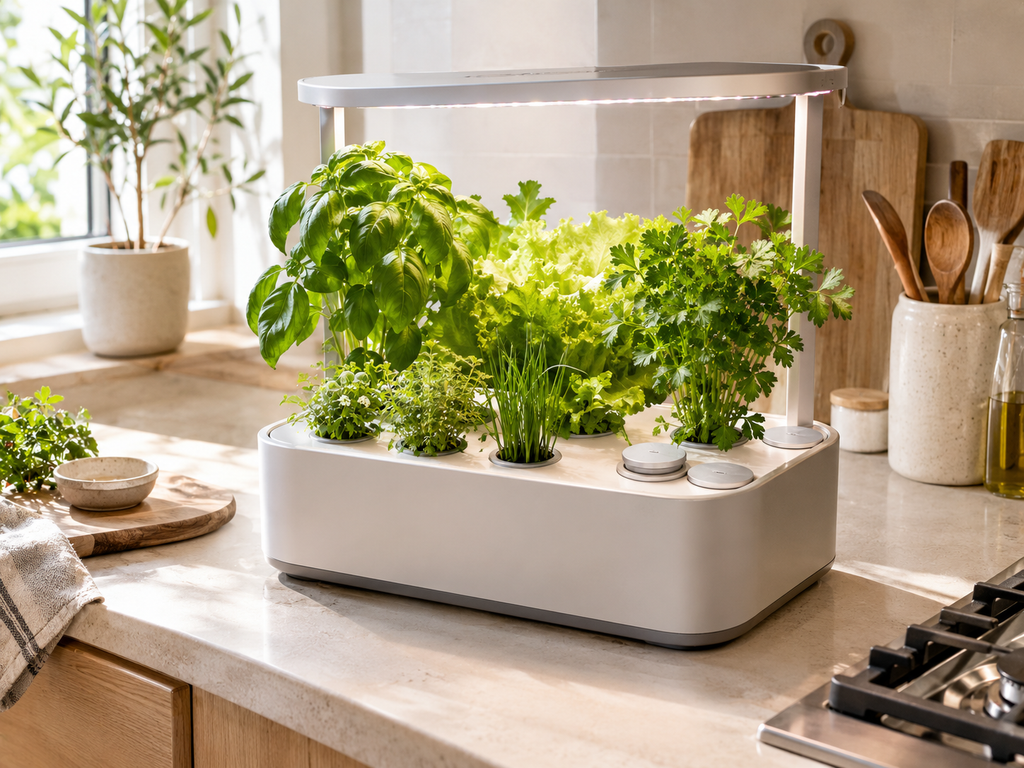
If you primarily want basil, mint, parsley and compact fruiting plants, prioritize light height and spacing over maximum pod capacity.
What Grows Best in a Countertop Hydroponic Garden?
The easiest plants are generally herbs and leafy greens.
Good starting choices include:
Basil because it grows vigorously and benefits from regular harvesting.
Leaf lettuce because it stays relatively compact and can be harvested continuously.
Parsley once established, although germination can require patience.
Chives because they take up little canopy space.
Dill if your garden has enough vertical clearance.
Cilantro with the understanding that it can be more temperamental than basil.
Bok choy and other compact Asian greens in larger gardens.
Mint can also grow extremely well, sometimes too well. Give it space and trim frequently.
What Should You Avoid Growing?
A countertop garden has obvious physical limits.
Large root vegetables such as carrots, full-size beets and potatoes are poor fits because the growing baskets do not provide the deep root environment those crops need.
Large vining plants such as cucumbers, pumpkins and melons quickly outgrow a countertop light.
Full-size tomatoes can also become far too large.
If you want fruiting plants, look for dwarf or compact cultivars and give them considerably more space than lettuce or herbs.
Hydroponic vs. Pod-Based Smart Gardens
There are two broad approaches in this list.
Hydroponic systems
LETPOT, iDOO, Spider Farmer, Ahopegarden, inbloom, URUQ and MUFGA primarily grow plants with roots accessing nutrient-rich water.
Advantages include greater seed flexibility and generally lower dependence on branded refill pods.
The tradeoff is slightly more maintenance. You will eventually need to clean the reservoir, manage nutrients and deal with roots.
Self-watering pod systems
Click & Grow takes a different approach.
Water moves into its growing medium through wicks, while the plant pods contain the growing medium and nutrients.
That reduces setup and maintenance dramatically.
The tradeoff is that you are buying into a more structured refill ecosystem.
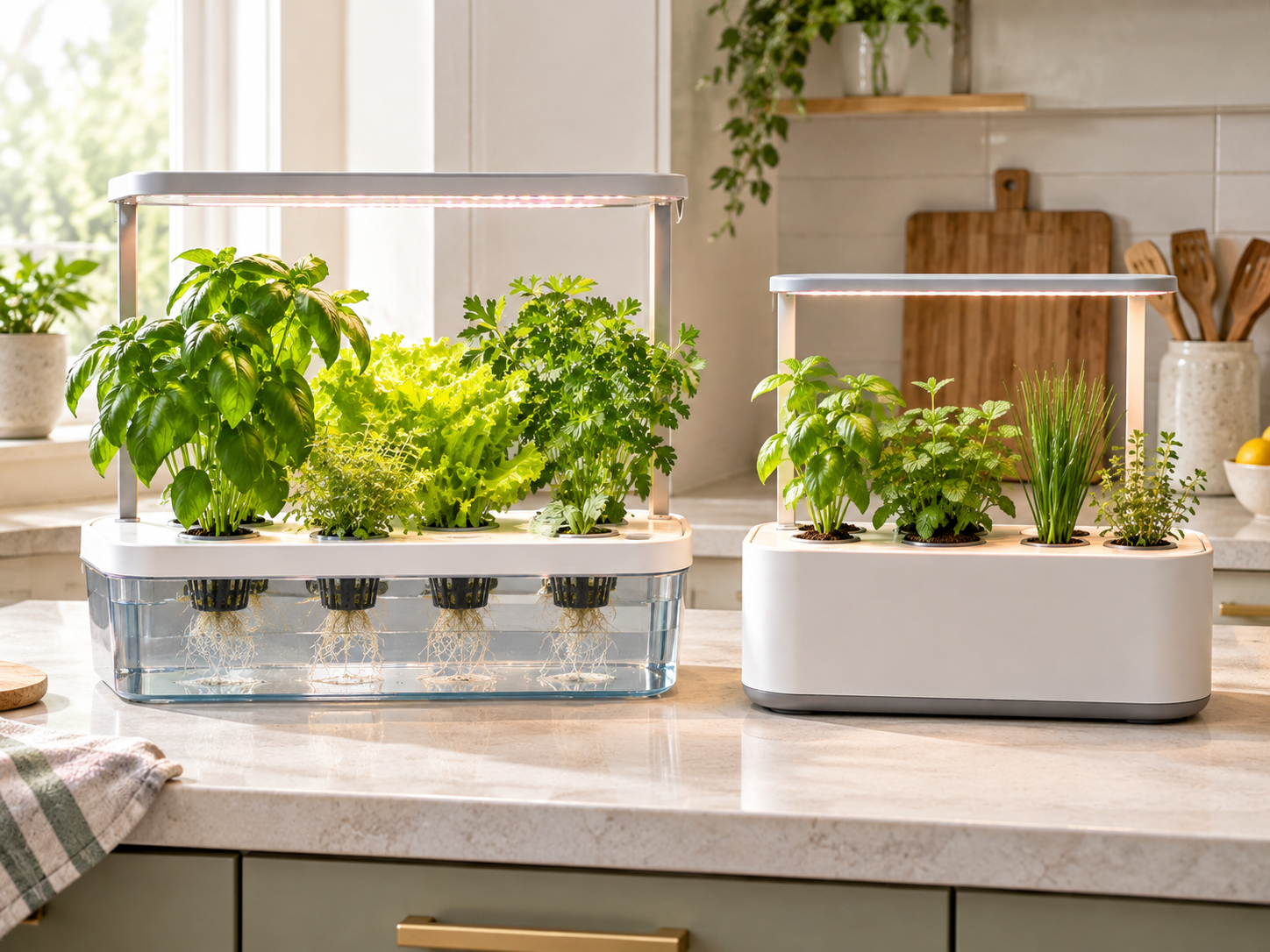
Neither approach is automatically better.
Choose based on whether you prefer flexibility or convenience.
How Much Counter Space Do You Need?
Measure before ordering.
And do not measure only width.
You need to know:
Width: Will it fit beside existing appliances?
Depth: Does it protrude into your preparation space?
Maximum height: Will the light hit an upper cabinet when fully extended?
Side clearance: Can mature leaves spread without touching a wall?
Access: Can you refill the reservoir without pulling the whole garden out?
That last one is easy to overlook.
A system that technically fits beneath your cabinets may still be frustrating if you cannot lift the reservoir cover once the plants are mature.
Are Indoor Smart Gardens Worth It?
They can be—if you value convenience, fresh herbs and the experience of growing food indoors.
They are much harder to justify if your only goal is saving money on vegetables.
A countertop system has an initial cost, uses electricity and requires replacement nutrients or growing media.
The real value is having living herbs and greens available when you actually need them.
Instead of buying a bunch of basil for one recipe and throwing away half of it, you harvest the leaves you need and leave the rest growing.
There is also a design element.
A well-maintained garden can bring living greenery into a kitchen that might otherwise have no natural plant life, particularly in apartments without usable outdoor space.
That is one reason we see indoor growing as part of the larger conversation around biophilic interiors rather than simply another kitchen gadget.
How to Make an Indoor Garden Look Good in Your Kitchen?
Do not treat it like something that needs to be hidden.
A healthy herb garden already adds color and movement.
Give it enough visual space so it does not look squeezed between a toaster and a pile of mail.
Systems with restrained finishes—particularly the Click & Grow models and premium stainless smart gardens—can sit comfortably in modern kitchens.
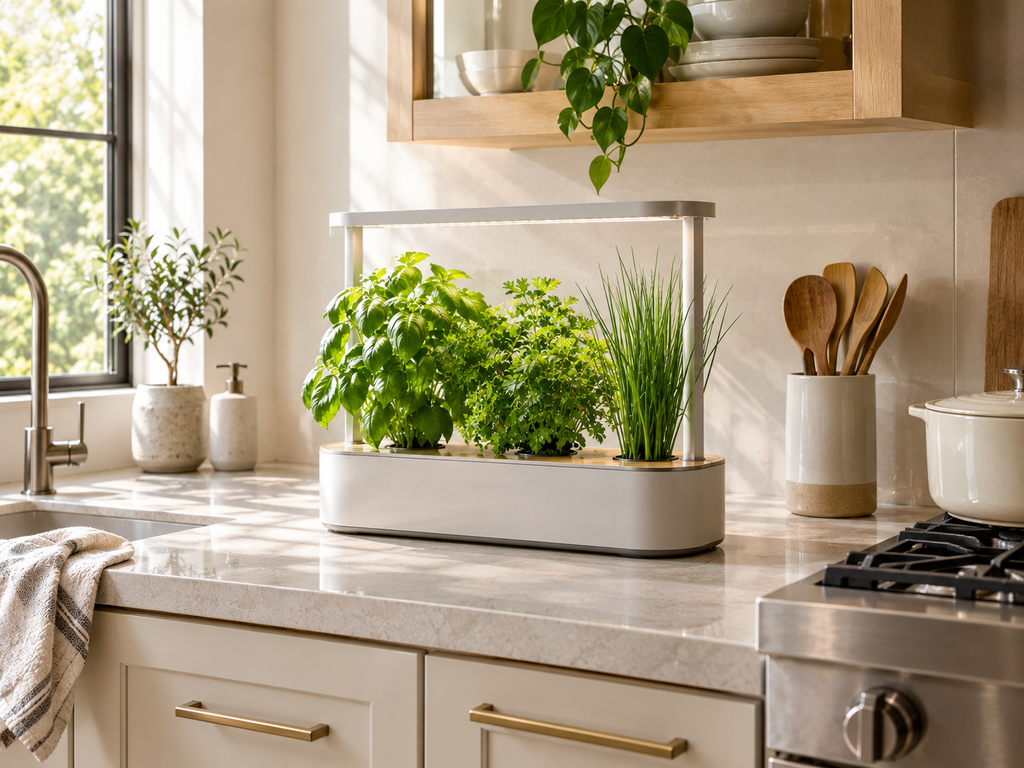
For more utilitarian systems, a dedicated section of counter or pantry worktop usually looks better than scattering accessories around the reservoir.
Keep nutrient bottles and replacement sponges in a cabinet rather than beside the unit.
And prune.
An indoor garden looks intentional when plants are full but controlled. Once basil is touching the light panel and mint is swallowing its neighbors, the effect changes very quickly.
Final Verdict
The best indoor smart garden is not necessarily the one with the most pods.
It is the one you will still want on your counter six months after the novelty wears off.
For a highly automated setup, the LETPOT LPH-Max is the standout.
For a more manageable premium garden, the LETPOT LPH-SE gives you twelve growing positions, app control and much of the flexibility most kitchens actually need.
For someone who wants almost no learning curve, the Click & Grow Smart Garden 9 is difficult to beat.
The iDOO 12-Pod and Ahopegarden 12-Pod are better fits when value matters more than connected features.
For small spaces, look at the URUQ 8-Pod, LETPOT LPH-Air or tiny Click & Grow Smart Garden 3.
Whichever system you choose, resist the temptation to fill every planting hole just because it is there.
Give your plants room, start with herbs and leafy greens, keep the reservoir clean and harvest often.
A countertop garden will not replace a backyard.
But for fresh basil beside the stove in January? It is a remarkably good little compromise.
Frequently Asked Questions
- What is the best indoor smart garden for 2027?
For maximum automation, the LETPOT LPH-Max is one of the strongest current choices because it combines a large 21-pod capacity with app control, automatic water refilling and automatic nutrient dosing. For most kitchens, however, a 10- or 12-pod garden may be easier to manage.
- What is the easiest indoor garden for beginners?
The Click & Grow Smart Garden 9 is one of the simplest because it uses passive watering and pre-seeded plant pods rather than requiring you to manage a conventional hydroponic nutrient reservoir. Its smaller Smart Garden 3 is even easier if you only want a few herbs.
- What is the best affordable smart garden with Wi-Fi?
The LETPOT LPH-Air is a strong value option because it combines ten planting positions with app and Wi-Fi control, customizable lighting and a 4L reservoir.
- Are indoor smart gardens actually hydroponic?
Many are, but not all. Systems such as LETPOT, iDOO and Ahopegarden circulate nutrient-rich water around plant roots. Click & Grow instead uses a passive self-watering system with proprietary growing pods.
- Can I grow tomatoes in a countertop smart garden?
Yes, but choose dwarf or compact varieties and give each plant considerable space. Tomatoes become much larger than lettuce or herbs and can quickly overwhelm neighboring pod positions.
- What are the best herbs for an indoor smart garden?
Basil, parsley, mint, chives, dill and cilantro are common choices. Basil is particularly rewarding because frequent harvesting encourages continued growth.
- How often does a countertop hydroponic garden need water?
It depends on reservoir size, plant maturity, temperature and what you are growing. Young seedlings may consume very little water, while mature leafy plants can empty a reservoir much faster. Larger tanks reduce how frequently you need to refill.
- Do you need sunlight for an indoor smart garden?
No. The systems in this guide include dedicated grow lights intended to provide the light plants need indoors. Natural daylight can still affect room temperature and growing conditions, but a sunny window is not required.
- Do indoor gardens need fertilizer?
True hydroponic systems require nutrients in the water because there is no nutrient-rich soil feeding the plants. Pod-based systems may include nutrients inside their growing medium, depending on the manufacturer.
- How often should you clean a hydroponic countertop garden?
Clean between major growing cycles and follow the manufacturer’s instructions. Roots, nutrient residue and algae can accumulate in reservoirs over time. Removing dead roots and keeping unused pod openings covered also helps.
- Can an indoor smart garden replace a vegetable garden?
Not realistically. Countertop systems are best thought of as herb-and-greens gardens. They are excellent for garnishes, regular herb harvesting and compact leafy crops, but they do not have the physical growing area required to replace a full outdoor vegetable garden.
- Do indoor plants or smart gardens purify the air?
Do not buy one for that purpose. Plants can have aesthetic and biophilic value, but ordinary quantities of indoor plants should not be treated as substitutes for ventilation or filtration. Our Biophilic Design Statistics & Research report looks at the underlying evidence in detail.